

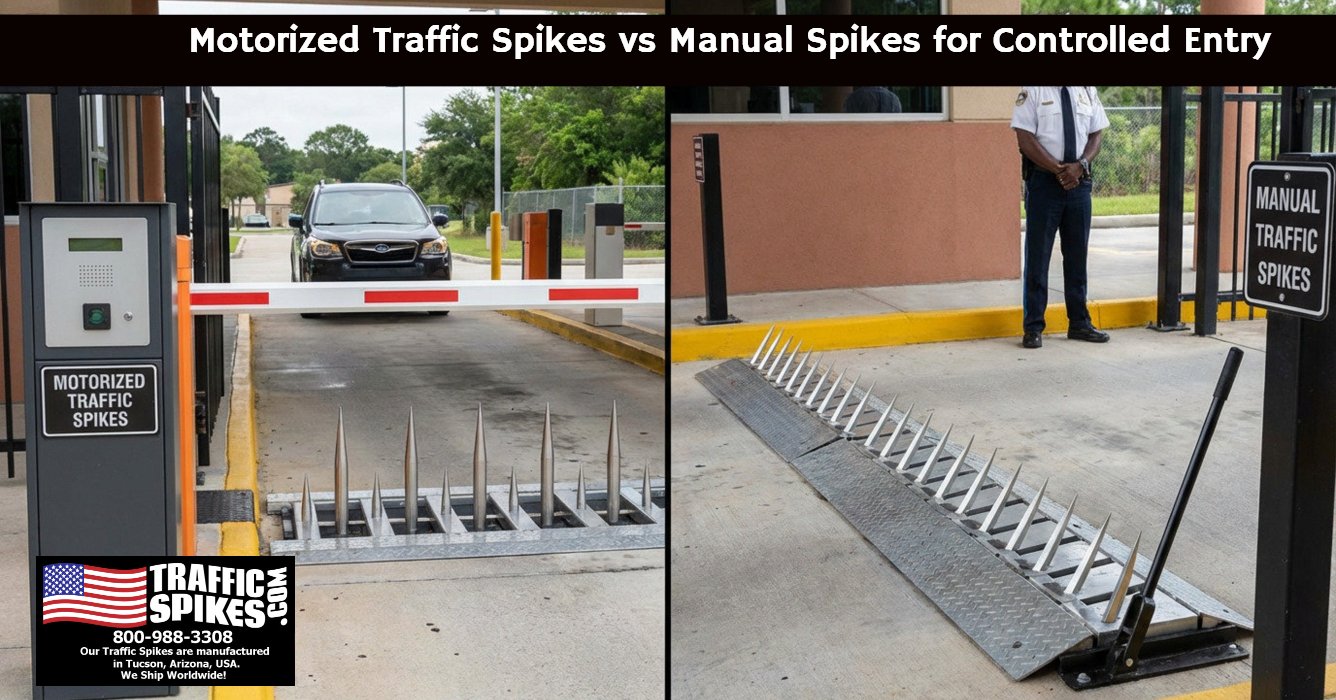
Wrong-way entry at a gate is one of those problems that feels small until it isn't. A delivery driver follows GPS into an exit lane. A former tenant tries the "back way" after hours. A car slips in behind a resident during rush hour. Suddenly you're dealing with damaged property, angry residents, and a safety risk that's hard to ignore.
That's where traffic spikes (often called tire shredders) come in. They're metal "teeth" installed in a driveway lane that allow travel in the approved direction, but punish wrong-way entry by puncturing tires at slow speed. They don't replace gates or access control, they reinforce them.
This post compares motorized vs manual traffic spikes for controlled entry, with a practical focus on security, safety, traffic flow, staffing, power needs, and total cost. If you're considering American-made options, TrafficSpikes.com (Tucson, Arizona) is one manufacturer to know. If you want help picking a setup, calling or requesting a quote is usually the fastest next step.
How manual and motorized traffic spikes work at a controlled entry point
At a controlled entry, the goal is simple: let authorized vehicles pass in the correct direction, and stop anyone trying to enter through an exit or restricted lane.
Picture what a driver sees. There's a lane with clear signs, maybe a gate arm, maybe a guard shack. The spike system sits across the pavement like a row of teeth angled in one direction. If the vehicle moves the right way, the teeth fold down. If the vehicle tries the wrong way, the teeth resist and puncture.
Both manual and motorized spikes can live in the same "stack" of site controls:
- Gates and arms to regulate timing and prevent tailgating.
- Keypads, card readers, remotes, or phone entry for permission.
- Signage and markings so drivers know the lane rules.
- Lighting and reflectors so no one "misses" the warning at night.
If you're mapping a full system, it helps to understand how spikes fit into broader access control planning. The overview on access control traffic spikes is a useful starting point because it frames spikes as part of a lane design, not a standalone gadget.
Manual spikes: simple, staff-operated control
Manual spikes are the "hand tools" of controlled entry. They're straightforward, and that's their appeal.
In a typical manual setup, an attendant or guard uses a local control (often a key switch, lever, or lock-down mechanism) to keep spikes in the position the site needs. When an authorized vehicle arrives, the operator confirms permission, then allows the driver to proceed in the correct direction. After the vehicle passes, the spikes return to their default one-way behavior, or the operator re-secures them depending on the site's rules.
Manual spikes tend to work best when a human is already stationed at the entry point and traffic volume is low. Think small private lots, back entrances, or an emergency-only lane that stays "closed" most of the time.
The trade-off is also simple: manual systems depend on people. If the attendant gets distracted, steps away, or waves through the wrong vehicle, you can end up with the very gap you installed spikes to prevent.
Motorized spikes: automatic raise and lower with access control
Motorized traffic spikes add automation. Instead of relying on an attendant to operate the lane, the system raises and lowers through a drive mechanism (commonly electric and mechanically actuated systems, and sometimes hydraulic designs in the broader market).
A motorized system can tie into the same tools you already use to grant access:
- keypad or phone directory entry
- card or fob readers
- remote controls at a guard post
- vehicle detection loops and presence sensors
- timed cycles to open and then return to secure mode
Most properties choose motorized spikes because they want consistent enforcement, especially after hours. If your gate is unmanned at 2 a.m., a motorized spike system doesn't get tired or look the other way.
Safety features matter here. You don't want spikes rising under a vehicle, so reputable systems use sensing and logic to prevent unsafe cycling. That's one reason integration planning (loops, sensors, and clear procedures) is as important as the steel in the road.
For a closer look at how automated systems are built for controlled entry, see motorized traffic spikes.
Side-by-side comparison that matters in real life: cost, speed, staffing, and reliability
Spec sheets are helpful, but most decisions come down to daily life. Morning rush at an HOA gate feels different than a warehouse shift change. A small office lot at night has different risks than a hospital ramp.
Here's a quick comparison that matches what boards, property managers, and facility leads usually care about. Use it as a discussion tool when you're collecting bids and writing up an approval memo.
| Factor | Manual spikes | Motorized spikes |
|---|---|---|
| Best fit | Low traffic, staffed entry | Medium to high traffic, unmanned lanes |
| Upfront cost | Lower equipment cost | Higher equipment and install cost |
| Operating cost | Often higher if staff must run it | Often lower if it replaces daily labor |
| Throughput | Slower, depends on attentiveness | Faster, consistent cycle timing |
| Power needs | None for operation | Needs power and protected controls |
| Failure planning | Human override is the default | Must define outage behavior and overrides |
The big takeaway is this: don't judge by purchase price alone. A manual system can be cheaper to buy, yet expensive to run if it requires daily staffing.
If you pay someone to "babysit" a lane every day, labor can outrun equipment savings faster than most budgets expect.
To add context on how one-way and retractable spike concepts differ (and where each tends to be used), this explainer is a helpful reference: one-way vs retractable spike strip basics.
Traffic flow and wait times at peak hours
Traffic flow isn't just about convenience. Long backups can trigger risky behavior. Drivers start tailgating through the gate arm. Visitors stop in the wrong place. Deliveries block the street. Then you get complaints, and sometimes accidents.
Motorized spikes usually win when vehicle volume is medium to high because cycle timing is consistent. The system opens, the vehicle clears, and the lane returns to secure mode without someone having to notice every moment.
Manual spikes can still work well when entries are rare and predictable. For example, a small office lot that only needs wrong-way protection at a single exit lane might never feel "busy." In that setting, manual operation or passive one-way behavior can be enough, as long as signage is clear.
Visitor management is where problems often show up first. A resident can learn the routine, but a guest or delivery driver arrives with zero context. If you expect frequent visitors, prioritize visibility, instructions, and a lane design that doesn't require guesswork.
Power, weather, and fail-safe planning
Motorized spikes need reliable power. That sounds obvious, yet it's where many projects stumble. You may need a dedicated circuit, protected conduit, surge protection, and a controller location that stays dry and secure.
Manual spikes have a clear advantage in remote areas, or places where power is unreliable. If your site loses power often, manual can keep you functional without a generator plan.
Now define "fail-safe" in plain English before you buy anything. In this context, fail-safe means: what happens during a power outage, emergency, or device fault. Does the lane default to secure mode (spikes up) or free mode (spikes down)? Who can override it, and how fast?
Also plan emergency vehicle access. Fire, police, and EMS need a known method to enter or exit without confusion. That's not only a hardware decision, it's a written procedure plus training.
Maintenance and durability differences you will actually notice
Every spike system lives in the real world, not in a brochure. Gravel migrates. Water pools. Snow gets plowed. Trash blows into corners. Those things matter.
Manual systems typically have fewer components that can fail. Basic inspections, cleaning, and hardware checks go a long way. Motorized systems have more parts, yet they can be very reliable when maintained on schedule, especially if the install includes good drainage and proper sensing.
No matter which type you choose, set a simple routine:
- Inspect for debris and stuck components
- Keep the lane clean, especially around moving parts
- Confirm signs and reflective markers remain visible
- Test operation on a set schedule, not "when someone remembers"
For visibility and driver behavior, accessories can do a lot of heavy lifting. Items like reflective elements and warning signs help reduce accidental strikes and confusion, especially at night. See traffic spikes accessories for examples of add-ons that support safer operation.
Which option is better for your property? Quick scenarios and a simple decision checklist
Choosing spikes is like choosing a lock. A basic lock is fine on a closet. A loading dock needs something tougher. The "right" answer depends on how people actually use your entrance.
Here are quick scenarios that match common US property needs:
- HOA or apartment gate: Morning and evening rush, guests, deliveries, and after-hours enforcement. Motorized often fits best if the gate is unmanned part of the day.
- Corporate parking: Predictable peaks, but tighter visitor control. Motorized helps keep rules consistent when staffing is light.
- Garage ramps: Visibility and low-clearance vehicles matter, so low-profile designs and strong signage become priorities.
- Airports or high-security sites: Higher threat concerns and strict procedures. Motorized with controlled logic and documented fail behavior is common.
- Loading docks and warehouses: Shift changes create bursts of traffic. Automation can reduce backups and driver frustration.
- One-way exits: Many sites just need reliable wrong-way prevention. Manual or passive one-way setups can be enough if traffic is light.
If you need a board-friendly checklist, bring this to the meeting:
- traffic volume at peak times
- hours of operation (24/7 or business hours)
- staffing reality (not staffing "on paper")
- power availability and outage history
- desired security level and threat concerns
- how often rules change (events, move-ins, deliveries)
For broader HOA traffic planning, including calming and signage strategy, this guide provides useful framing: HOA traffic calming plan guide.
Choose manual spikes when simplicity and low traffic matter most
Manual spikes make sense when the lane is quiet and the rules stay stable.
They're a strong fit when you have low daily entries, a staffed gate, a tight equipment budget, or no dependable power at the location. They also work well when you only need spikes as an occasional control, like locking down an exit lane during certain hours.
The biggest risk is human error. Miss one operation, and you may leave a lane open at the wrong time. Training helps, but procedures matter more. Write down who operates the control, when they do it, and what they do when something looks off.
Choose motorized spikes when you need fast, 24/7 control with less labor
Motorized spikes are usually the better choice when traffic volume is medium to high, when you can't justify a guard full-time, or when you want consistent enforcement without relying on memory and attention.
They also shine when you need integration with access control. If you already use card readers, keypad entry, or managed visitor systems, motorized spikes can match that workflow and keep the lane behavior consistent.
Installation planning is more involved, so don't rush it. Confirm power, drainage, sensor placement, signage, and emergency procedures before anyone cuts pavement. Most importantly, insist on safety sensing and clear lane markings to reduce accidental wrong-way attempts.
Conclusion
Manual spikes usually win on lower equipment cost and operational simplicity, especially in low-traffic, staffed areas. Motorized spikes typically win on speed, automation, and consistency, which matters most at busy or unmanned entrances.
The right choice depends on traffic volume, staffing, power reliability, and the level of security you need. If you're deciding between surface-mount vs in-ground options, or sizing a system for cars, delivery vans, or heavier loads, TrafficSpikes.com can help you narrow it down. To move forward, call or use the contact or quote form and ask for a recommendation based on your lane layout and daily traffic patterns, so you end up with a controlled entry that stays predictable all year.
Call Today!! 800-988-3309